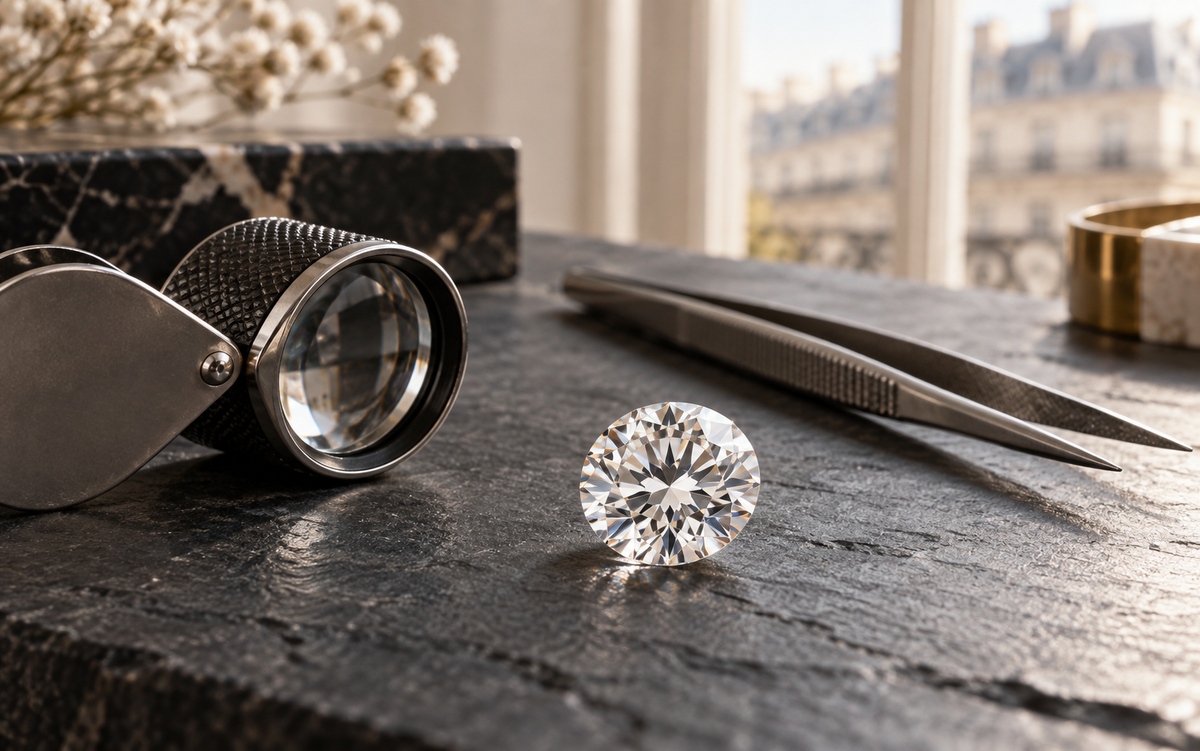
One reference reads “F VS1”. Another reads “D VVS2”. These letters describe a diamond, but on their own they do not tell us everything we will see once the stone is set.
To prepare a consistent selection, three questions need to be distinguished: what is its colour, what characteristics does it have, and how does it interact with light?
Colour: what do D, E and F mean?
For diamonds in the colourless to lightly tinted range, the reference scale runs from D to Z. D represents the absence of colour on this scale. Grades D, E and F belong to the colourless category.
The difference between adjacent grades can be subtle. Grades are assigned under controlled conditions by comparison with reference stones: a photograph on a screen is therefore not enough to confirm colour.
This approach should not be applied directly to coloured diamonds, which are assessed using different criteria.
Clarity: understanding VVS and VS
Clarity describes internal characteristics, called inclusions, and certain surface characteristics. It is assessed notably under 10× magnification, taking their visibility, position and nature into account.
- VVS1 and VVS2: inclusions that are extremely difficult for a professional to observe under these conditions.
- VS1 and VS2: minor inclusions, generally easier to detect than those in the VVS categories.
A VVS grade does not mean “absolutely flawless”. Conversely, a VS grade does not imply that an inclusion will be visible to the naked eye. The stone’s dimensions, shape and inclusion locations also matter. Two different grades can therefore offer a very similar visual appearance.
Cut: shape is not the whole story
Round, oval, pear and emerald refer to a shape and faceting style. Cut quality concerns, among other things, proportions and the way facets interact with light. Polish and symmetry complete the picture.
Look at what is actually assessed on the report: at GIA, the overall cut grade in the traditional D–Z system applies to the standard round brilliant. You cannot assume that an oval or emerald cut has a directly comparable grade. Good colour and high clarity do not replace an assessment of light performance.
And carat? Weight, not a quality grade
Carat measures mass: 1 ct = 0.20 gram. Millimetres describe dimensions. At equal weight, different shapes or proportions can create a different visual presence.
For a lot, consider consistency too
When preparing your enquiry, we invite you to specify the intended use: centre stone, halo, pavé or a series of jewellery pieces. Add the shape, desired dimensions, total weight required, and colour and clarity requirements.
On a product sheet, a range such as “D–E–F / VVS–VS” is not a precise description of every stone. Ask what the proposed selection covers and which documents are available for the reference or lot concerned. Do not assume that a lot automatically comes with an individual report for each stone.
For lab-grown diamonds too, read the document actually supplied: terminology and formats can vary by laboratory and service. Origin information must remain separate from quality information.
Key takeaway
Colour, clarity, cut and weight should be considered together. The aim is not simply to combine the highest grades, but to define a selection suited to the jewellery design and a clear specification.
Explore diamond shapes or discuss your project with Comptoir Haussmann.