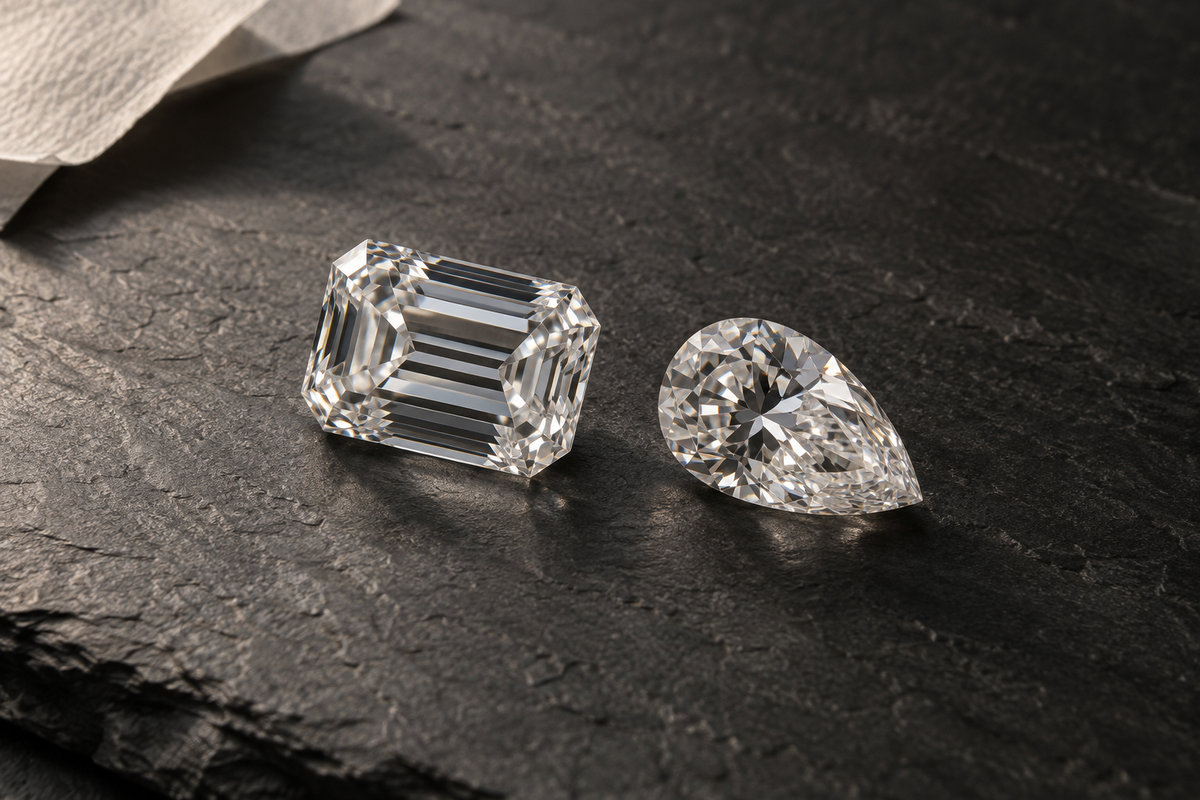
At first glance, nothing seems to separate them: a lab-grown diamond and a natural diamond can display the same play of light. This similarity is no illusion. A lab-grown diamond is a diamond, not an imitation. For a jewellery professional, the key is to understand what they share — and clearly identify what distinguishes them.
The same material, a different origin
Diamond consists of carbon arranged in a particular crystal structure. A laboratory-created diamond has essentially the same chemical composition and physical and optical properties as a natural diamond. It is therefore not comparable to moissanite or cubic zirconia, which are different materials that can resemble it.
The fundamental difference lies in its history. A natural diamond formed within the Earth. A lab-grown diamond grows under controlled conditions, notably through HPHT, using high pressure and high temperature, or CVD, depositing carbon from a gas.
Brilliance that is no imitation
A lab-grown diamond has the properties of diamond that produce its brilliance and play of light. However, origin alone does not guarantee a beautiful stone: cut quality, proportions, colour and clarity characteristics remain decisive.
Two lab-grown diamonds can therefore differ greatly in quality, just as two natural diamonds can. When choosing a stone, it is better to examine its actual characteristics than to rely solely on the label “natural” or “lab-grown”.
Similar does not mean indistinguishable
Growth conditions leave signatures that enable gemmological laboratories to distinguish these origins using suitable equipment. Observation with the naked eye, or a conventional diamond tester, is not enough to establish with certainty that a stone is natural.
This is important: saying that a lab-grown diamond is a real diamond does not mean it should be presented as a natural diamond. Its origin must remain clear, from the supplier through to the end customer.
The right choice depends on the project
Natural and lab-grown diamonds have different histories and market positions. Their material similarity does not imply equivalent prices. For a jewellery design, start by defining the shape, dimensions, desired appearance and budget, then compare precisely described stones.
A lab-grown diamond is not a copy of a diamond: it is a diamond grown in a different environment.
At Comptoir Haussmann, we aim to make these distinctions clear for professionals. Are you preparing a collection or looking for a particular size? Let’s discuss your project.